
Built for the Transparency Act and ISO audit
Supplier Evaluation Gathers the entire supplier base in one place. This way, you can show auditors and customers how each individual supplier was assessed, without having to search through Excel.





Three roles that need an overview of suppliers
If anyone asks you why a particular supplier is critical, or how you comply with the Transparency Act, the answer must be one click away.
Purchasing
Procurement managers, responsible for purchasing
Many suppliers in various categories, with long-standing relationships. You must be able to show why one supplier is critical, and why another was eliminated.
Quality & HSE
Quality Managers, QA Coordinators
ISO 9001, 14001 and 45001 set requirements for supplier management. You must be able to document that assessments have been carried out, not just claim that they have.
Leadership
Daily managers, finance managers, boards of directors
The Transparency Act requires due diligence assessments to be documented and published. When the Consumer Authority or a customer requests access, the answer must be found without a week of searching.
When you have 20 suppliers, Excel works. When you have 200, it takes a working day to check who still has a valid ISO 45001. It's a growing pain. Supplier evaluation makes it a working process.
What will you get with Supplier Evaluation that is not in a spreadsheet
Manual follow-up in Excel and email works for a while. Supplier evaluation comes in when the supplier base grows, certificates begin to expire, and someone suddenly asks how you comply with the Transparency Act.
Take a look at Supplier Evaluation in Business Online
A supplement to the due diligence assessment
If your company is subject to the Transparency Act, supplier due diligence is a crucial part of your operations. With the Supplier Evaluation feature in Business Online, you get a centralized overview of all assessments conducted for each supplier.
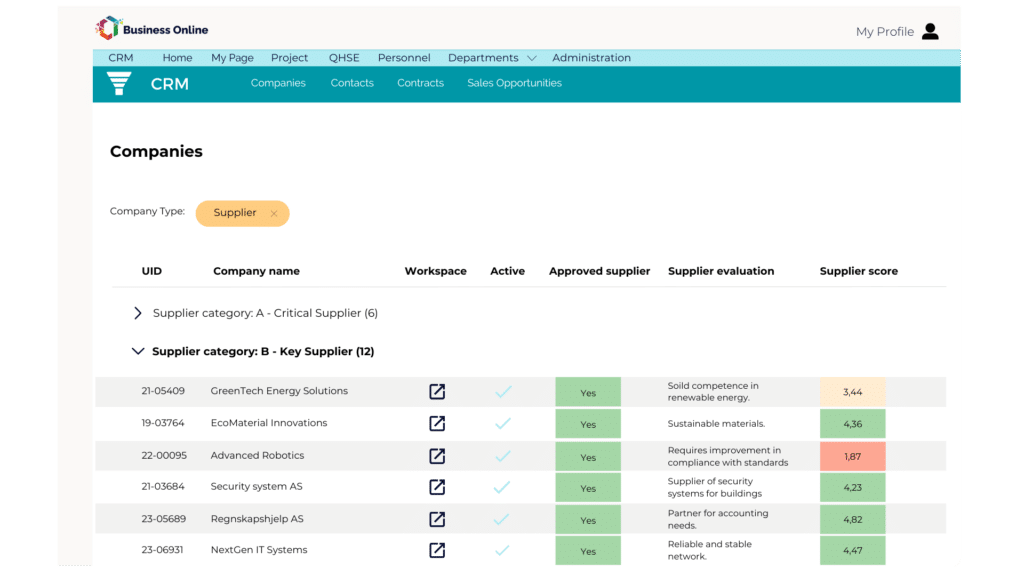
List view of suppliers with approval status and supplier scores
Perform periodic evaluations
Each supplier has a dedicated workspace where all relevant information is stored in one place. With the Supplier Evaluation feature, you can also consolidate all periodic assessments of each supplier in one centralized location.

Workspace for a supplier, with supplier evaluation functionality in the side menu
Standardized Evaluation Form
The same evaluation form is used across all suppliers registered in Business Online. You have full control over how each supplier is rated on the scale, making it both simple and flexible to set your own standards.

Supplier evaluation form
Three common questions before you proceed
What do we need to document to comply with the Transparency Act?
The Transparency Act requires companies above a certain size to conduct due diligence assessments of their suppliers and to demonstrate how these assessments have been carried out. Supplier evaluation collects these assessments in a structured format with date, responsible person, category, and result. You can retrieve the entire history when someone requests access.
The actual publication of the due diligence assessment is a separate step that you still own. Supplier evaluation provides the basis from which to publish.
How do we categorise critical suppliers?
Each supplier is given a category based on their role in the value chain. The default setup is A-critical, B-important, C-standard, but you can customise the categories to how you think. The category controls how often the supplier should be assessed and which criteria apply.
The category can change as the delivery evolves. A supplier that becomes more critical to production is moved up.
How do we document that a supplier is ISO certified?
Each supplier has their own workspace where you can register certifications with their expiry dates and upload documentation. The system sends a notification when a certificate is nearing expiry, so you won't only find out when the auditor asks.
This applies to ISO 9001, 14001, 45001 and other standards you may need to keep an eye on.
Questions you likely have before you raise this internally
The Transparency Act requires you to conduct, document, and publish your due diligence assessments. Supplier evaluation handles the part about doing and documenting in one place, and provides the basis for what you need to publish. The actual publication is a separate step that you still own.
Yes. The form is standardised in its basic layout, but criteria and weighting are set up per business unit. If you measure suppliers on delivery precision or HSEQ performance, the form will reflect that.
Certifications are registered with an expiry date. When a date approaches or a certification is withdrawn, a notification appears and the supplier gets a new status in the list. You discover it before the auditor.
Supplier evaluation is included in the CRM section of Business Online. Supplier data can be synchronised with Tripletex and Visma Net, as well as other system suppliers with Business Online Connector.
The frequency is set per category. Critical suppliers are evaluated more often than standard suppliers, and the specific interval is set up together with a consultant from Business Online based on industry requirements and your own routines. The system sends reminders when the next evaluation is approaching, so nothing is forgotten.
Ready to grow, without the growing pains?
See Business Online in action. 30 minutes. No commitment.